
When doing nothing is best
Markets may fall, but recovery is part of the process.
“History doesn’t repeat itself, but it does often rhyme.”
There is some doubt over whether Mark Twain actually said that, but the passage of global stock markets so far this year has certainly reinforced his claim. It’s a line that long-term investors need to keep in mind.
Investing is inherently risk. Markets do go down as well as up. Investors demand higher returns as the price for taking on that risk. If there was no extra reward, investors wouldn’t commit their money and would stick with ‘safer’ assets. That’s why the stock market rises over the long term.
There is no denying that sometimes those market falls can be gut-wrenching, particularly when they get into bear market territory, commonly defined as a fall of more than 20%. The high inflation shock of 2022 was the last such fall, which was compounded by the outbreak of the Russia-Ukraine war.
On that occasion, it took until early 2024 for markets to fully recover their losses. But that’s the important point to remember; markets do recover. That’s what history shows us.
Most recently, of course, investors have had to contend with the fall-out from the Middle East conflict.
In the face of uncertainty, markets sell first and ask questions later. The US S&P500 index fell nearly 10% in the initial weeks of the war but staged a full recovery in just 11 trading sessions. The speed of the rebound was remarkably swift, especially as there had been no resolution to the conflict.
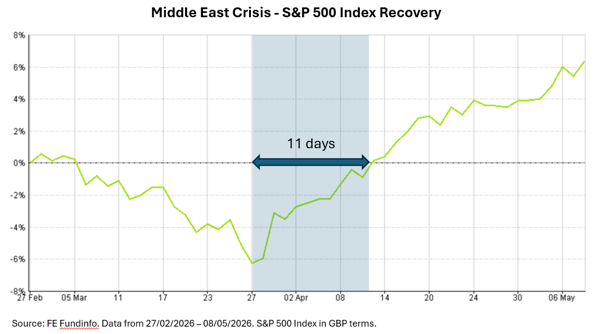
The past shows that it’s reasonable to expect a market correction about every 2-3 years. However, the time it takes markets to recover does vary depending on how the economic and geopolitical situation unfolds.
Don’t panic
So, what should investors do when the going gets tough? The right thing to do is to sit tight.
Have your objectives or timescales changed? If you’re investing for long-term goals, you don’t need the money next week, next month, or even next year. If you get caught up in the emotion and uncertainty of short-term events, there’s a danger you’ll sell out and miss out on the subsequent recovery.
Ultimately, long-term stock market returns are driven by the earnings and durability of successful companies, not geopolitical events. That’s why it’s vital for investors’ portfolios to be fully diversified and not over-exposed to adverse outcomes.
It’s not always easy to tune out to the noise when markets falter. Yet the key to long-term investment success is to remain invested and give markets the time to compound your returns.
The value of investments and any income from them can fall as well as rise and you may not get back the original amount invested.
Past performance is not a reliable indicator of future performance and should not be relied upon.
Approved by 2plan financial management Ltd on 11/06/2026
Miller James Financial Planning Ltd is an appointed representative of 2plan Wealth Management Ltd which is authorised and regulated by the Financial Conduct Authority. Miller James Financial Planning Ltd is entered on the FCA register (www.fca.org.uk) under 972481. Miller James Financial Planning Limited is registered in England & Wales no. 08844794. Registered Office at Delta 606 Welton Road, Delta Office Park, Swindon, SN5 7XF.